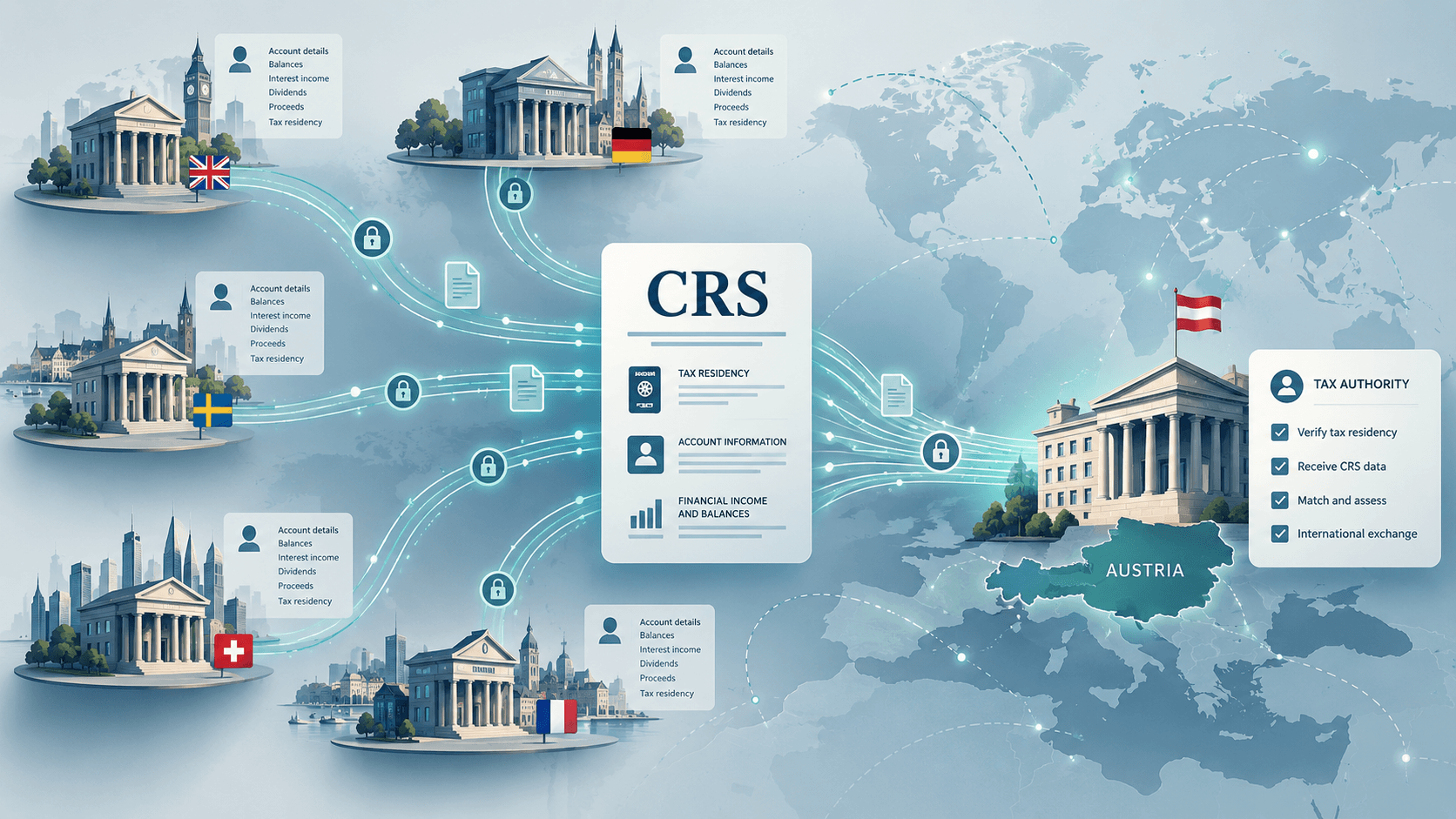
For years, crypto-assets were often perceived as operating outside the traditional banking system. From a tax transparency perspective, that distinction is rapidly disappearing.
New reporting rules based on DAC8 and the OECD Crypto-Asset Reporting Framework (CARF) apply from 2026. Information relating to the 2026 reporting year will be reported and exchanged between participating tax authorities from 2027.
What is changing?
Traditional automatic exchange of information has primarily focused on bank accounts and conventional financial investments.
Crypto-assets created a significant gap in that system.
Austria has therefore introduced the Crypto-Asset Reporting Act, requiring covered crypto-asset service providers to identify users, establish their tax residence and collect information required for tax reporting.
Reporting is transaction-based
Unlike the traditional reporting of financial accounts, crypto reporting is not limited to providing a year-end account balance.
The new framework is transaction-based, allowing tax authorities to receive information on relevant transactions involving crypto-assets.
The rules also require relevant service providers to obtain tax-residence information from existing crypto users during the transitional period.
Why does 2027 matter?
2026 is the first reporting period.
The information collected for that year will be reported in 2027 and subsequently exchanged automatically between participating jurisdictions.
This is particularly relevant for Austrian tax residents using foreign crypto exchanges or other crypto service providers located outside Austria.
Does reporting automatically mean tax is due?
No.
A reported crypto transaction does not automatically result in an Austrian tax liability.
The tax treatment depends on the type of asset, the acquisition date, the nature of the transaction and other circumstances.
What changes is the amount of information available to tax authorities and their ability to compare information received from foreign providers with Austrian tax returns.
What should crypto investors do now?
Austrian tax residents holding or trading crypto-assets should ensure that their transaction records are complete.
Purchases, sales, exchanges, transfers between personal wallets and transactions across different platforms should be traceable.
This becomes particularly important where several exchanges or wallets have been used over multiple years.
The key development is therefore not the introduction of a new “crypto tax”, but a substantial increase in international tax transparency.
steuerexperten.at assists clients with the Austrian tax treatment of crypto-assets and the correct reporting of crypto transactions.